SEO / Google / Organic traffic
What Is SEO and How Long Does It Take to Work?
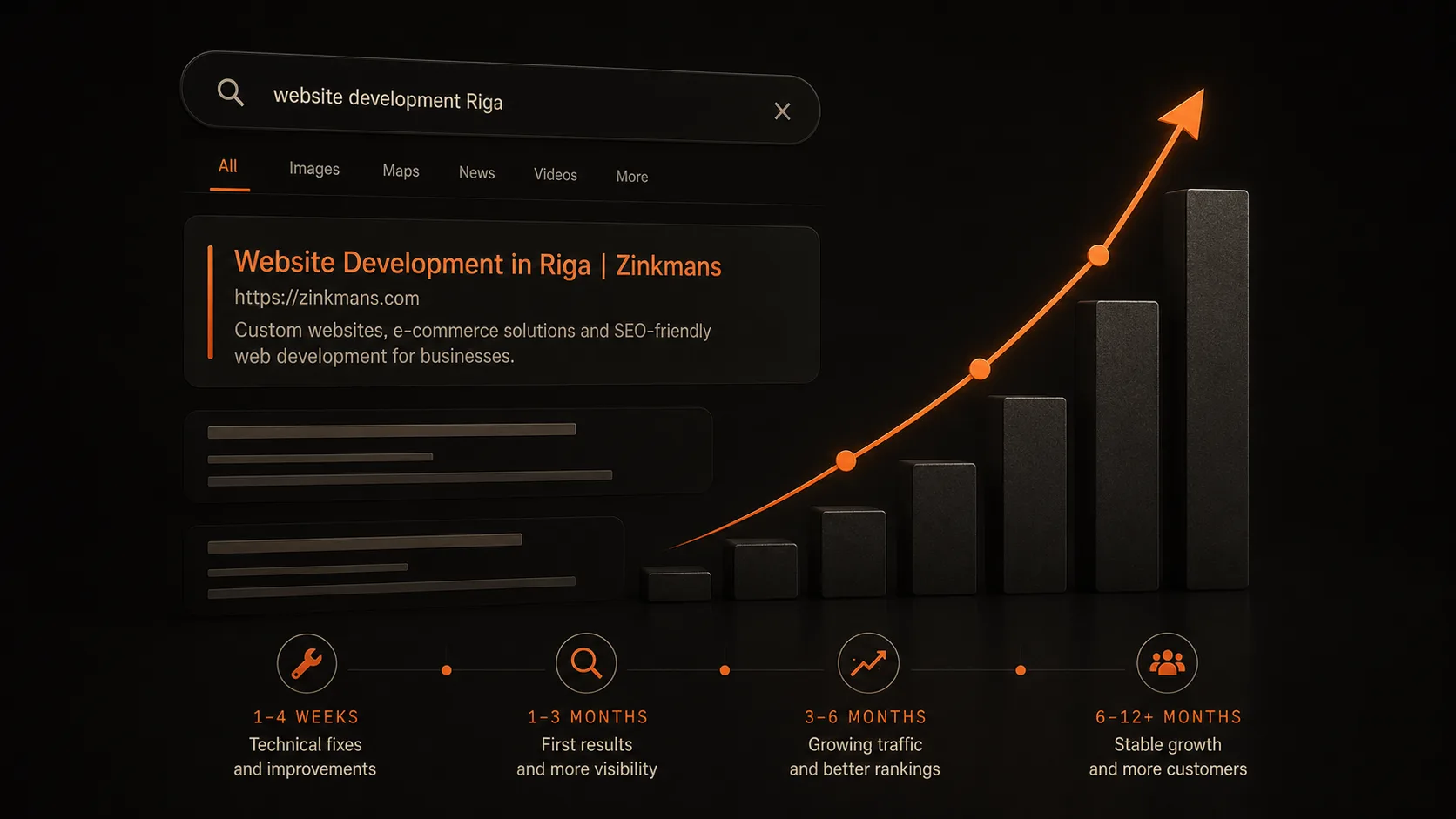
SEO helps your website become more visible in Google Search and reach people who are already looking for a relevant product or service. However, SEO is not an instant solution. Initial changes may appear within a few weeks, while stable results usually require several months of consistent work.
The main idea
Initial improvements may appear within a few weeks, but stable growth in organic traffic and customer enquiries usually requires several months.
What is SEO?
SEO stands for Search Engine Optimization.
In simple terms, SEO is a combination of improvements that helps Google find your website, understand its content and show it to people searching for relevant information, products or services.
A practical example
A potential customer searches Google for “website development in Riga”. If your website is relevant to that search, technically sound and provides useful information, Google may display it in the search results.
Visits coming from regular Google search results rather than paid advertisements are known as organic traffic.
How does SEO work?
Google aims to show people the most useful and relevant results for each search. SEO helps search engines understand what a website is about and which searches it may be suitable for.
SEO is not based on one keyword or one technical setting. It consists of several connected areas.
Useful information
Website content should answer potential customers’ questions and clearly explain what the business offers.
A well-built website
Google must be able to access, read and understand the website without technical obstacles.
Online reputation
Reviews, project examples and relevant links from other websites help establish trust and authority.
Easy to use
Visitors should be able to find the information they need and understand what to do next.
Website content
Website content should be clear, useful and written for real people. Potential customers should easily be able to understand:
- what the business offers;
- who the service is intended for;
- how the cooperation process works;
- what benefits the customer receives;
- how much the service may cost;
- how to contact the business.
The goal is not to repeat the same keyword as many times as possible. The content should provide a useful and complete answer to the visitor’s question.
Technical website quality
Google must be able to access, read and include the website in its search index.
A well-optimised website should:
- load efficiently;
- work well on mobile devices;
- avoid broken links;
- have a clear and logical structure;
- use a secure HTTPS connection;
- allow Google to access important pages.
Even excellent content may struggle to achieve results when the website has serious technical problems.
Website trust
Google also considers the overall quality and reliability of a website. Trust can be supported by accurate business information, genuine customer reviews, examples of completed work, regularly updated content and relevant links from other websites.
User experience
SEO is not only about Google. A website must also be easy for real visitors to use.
A high search position will not generate customers when visitors cannot find the information they need, understand the offer or complete the contact form.
How long does SEO take to work?
There is no exact timeline that applies to every website because every situation is different.
Google may notice some technical changes relatively quickly. However, meaningful growth in organic traffic, search positions and customer enquiries usually requires several months.
Building the foundation
The process usually begins with a website audit and the identification of the most important problems.
- technical errors are fixed;
- page titles and descriptions are improved;
- the website structure is organised;
- existing content is updated;
- Google Search Console is configured;
- the mobile version is reviewed.
The first signals
The website may begin appearing for more searches, improving its position for selected keywords and attracting additional organic visitors.
Results may still fluctuate during this stage. Search positions may improve one week and decrease slightly the next.
A clearer growth trend
With consistent SEO work, organic traffic, visibility for important pages and the number of potential customer enquiries may begin to increase more noticeably.
More stable long-term results
In competitive industries, achieving significant results may require six, twelve or more months.
A longer period is especially common for new websites and businesses whose competitors have already invested in SEO for several years.
Important
These time ranges are a general planning guide, not a guarantee. No responsible provider can guarantee a specific Google position by a specific date.
What affects the speed of SEO results?
The current condition of the website
An established website with useful content, a good reputation and regular visitors may respond to improvements faster than a completely new website.
When a website has many technical errors, weak content or a confusing structure, the basic problems must be corrected first.
Competition in the industry
Ranking for a highly specific service in a small local area is usually easier than competing for a popular service across an entire country.
The stronger the competitors are, the more time and high-quality work may be required.
Content quality
Ten short and superficial articles do not necessarily produce better results than a few carefully prepared resources.
Useful content should help the reader:
- understand the problem;
- compare possible solutions;
- make an informed decision;
- identify the next step.
Technical quality
A slow, unreliable or mobile-unfriendly website may limit SEO performance. Technical improvements make it easier for both Google and visitors to access and use the website.
Consistency
SEO is not a one-time task. Competitors publish new content, customer searches change, and technical problems may appear over time.
Better long-term results usually come from a consistent process: research, improve, measure and repeat.
How can you tell whether SEO is working?
SEO should not be measured only by checking the position of one keyword or by searching for the company name.
It is more useful to analyse the overall trend:
- how often the website appears in Google Search;
- which searches bring people to the website;
- how many people click on the search result;
- which pages attract the most visitors;
- whether organic visitors submit enquiries;
- whether SEO contributes to sales or other business goals.
This information can be analysed with Google Search Console and website analytics tools.
What should a business measure?
Search positions are useful, but the main business goal is usually not simply to appear in Google. The most important question is whether visibility creates qualified visits, customer enquiries and sales.
Can anyone guarantee first place in Google?
No. No responsible SEO specialist can guarantee the number-one position in Google.
Search results are influenced by many factors, and competitors are also continuously improving their websites.
Be cautious of offers promising
- first place in Google within a few days;
- a guaranteed number of visitors;
- hundreds of artificially created links;
- results without improving the website;
- secret methods for achieving instant rankings.
Poor-quality methods may create temporary improvements, but they can damage the website’s long-term visibility and reputation.
Is SEO worth it?
SEO is particularly valuable for businesses whose customers use Google to find products, services or answers to their questions.
Paid advertising generally works while the business continues paying for clicks. A useful service page or blog article may continue attracting visitors long after it has been published.
This does not mean that SEO is free. It requires investment in research, technical improvements, content creation and regular performance analysis.
The main advantage of SEO is the ability to reach people at the moment when they are already actively searching for a relevant solution. Learn more about our approach on our SEO services page.
Conclusion
SEO helps Google understand a website and helps potential customers find it.
Initial changes may appear within a few weeks, but stable growth in organic traffic and customer enquiries usually requires several months.
Long-term results do not come from one keyword or a quick trick. They are built through a technically sound website, useful content, a good user experience and consistent improvements.
Frequently asked questions
How quickly will Google notice changes to a website?
Some changes may be noticed relatively quickly, but their effect on rankings and traffic may only become visible after several weeks or months.
Does SEO take longer for a new website?
Often, yes. A new website has not yet established a strong reputation, content history or external links, so stable results may require more time.
Is publishing one blog article enough?
One useful article may attract visitors, but long-term SEO normally requires consistent work on content, technical quality and existing pages.
Can SEO replace paid advertising?
Not always. SEO and paid advertising solve different problems. Advertising can provide faster visibility, while SEO helps build more sustainable long-term organic traffic.
Article topic: SEO · Google · organic traffic